
Attendance Behavior and Rebooking Scenarios#
Overview#
Once appointments are generated, not all patients attend.
Some cancel, others miss their visit entirely, and some are rebooked.
The parameters status_rates and rebook_category jointly control these post-booking behaviors, shaping the realism of appointment outcomes over time.
You will explore three practical scenarios:
A balanced system with typical attendance and partial rebooking.
A no-rebooking system representing rigid scheduling (lost cancellations).
A highly adaptive system with full rebooking and low non-attendance.
Each scenario shows how these parameters modify attendance outcomes and day-to-day clinic activity.
Example 1 – Balanced outpatient attendance (default behavior)#
A standard clinic using NHS-derived attendance proportions and 50% rebooking intensity.
from medscheduler import AppointmentScheduler
from medscheduler.utils.plotting import (
    plot_appointments_by_status,
    plot_appointments_by_status_future,
    plot_status_distribution_last_days,
    plot_status_distribution_next_days,
)
import pandas as pd

sched_default = AppointmentScheduler(
    date_ranges=[("2024-01-01", "2024-12-31")],
    ref_date="2024-11-25",
    fill_rate=0.85,
    rebook_category="med"
)

slots_df, appts_df, patients_df = sched_default.generate()

# Visualizations
plot_appointments_by_status(appts_df, scheduler=sched_default)
plot_appointments_by_status_future(appts_df, scheduler=sched_default)
plot_status_distribution_last_days(appts_df, scheduler=sched_default, days_back=21)
plot_status_distribution_next_days(appts_df, scheduler=sched_default, days_ahead=21)
Output preview:
Below are the four main outputs for this configuration:
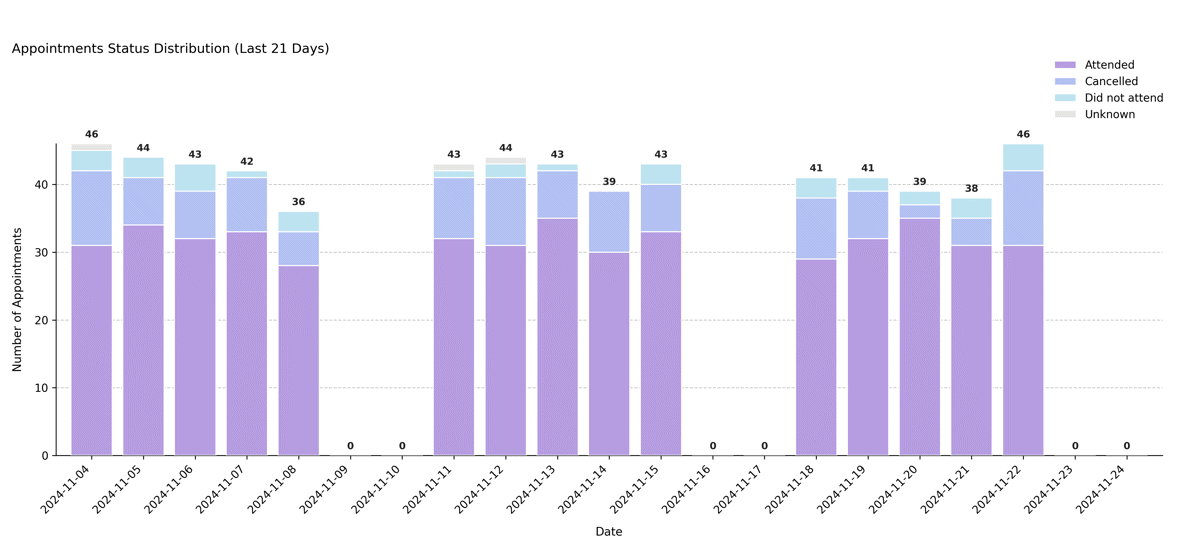
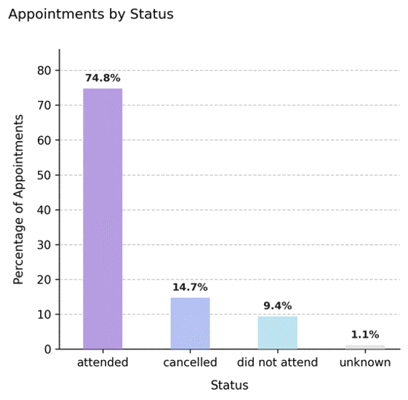
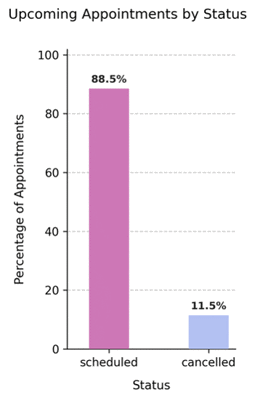
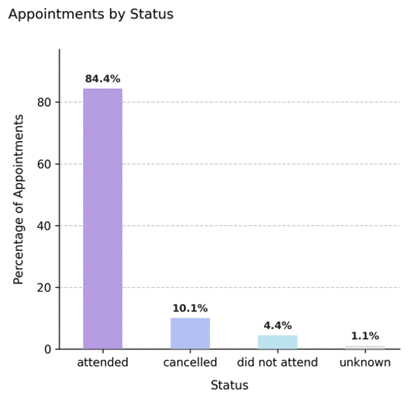
Past appointment outcomes – Proportion of attended, cancelled, and missed visits before the reference date.

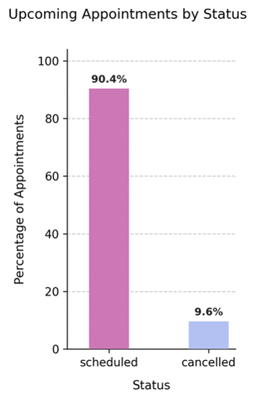
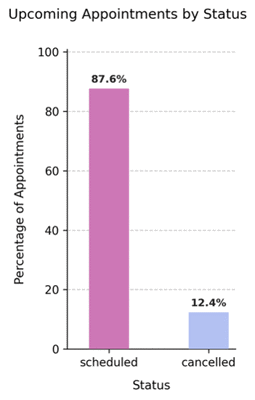
Future appointment outcomes – Expected proportions for upcoming appointments.
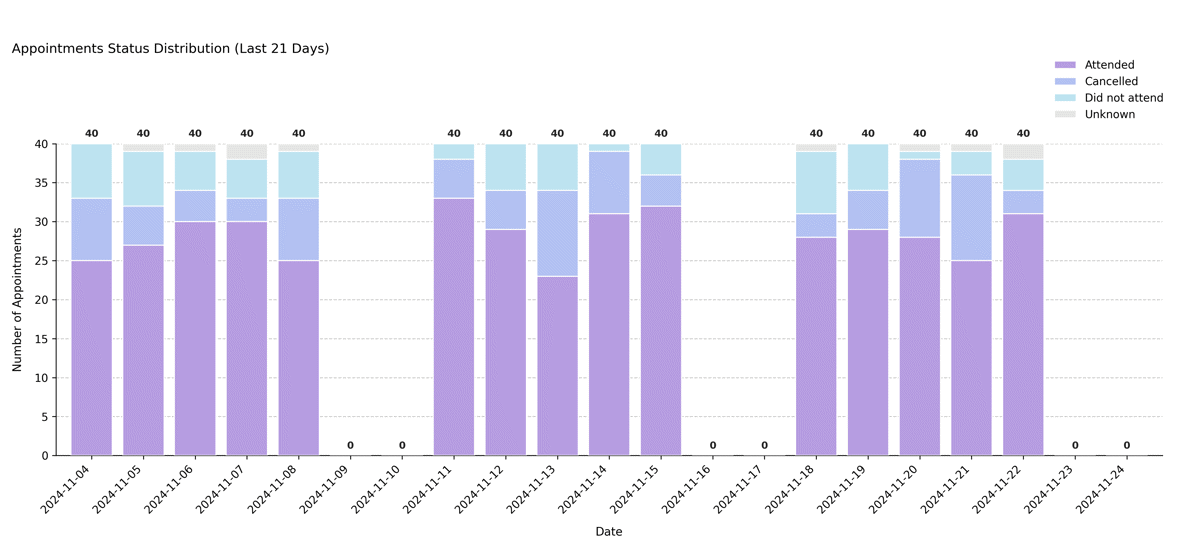
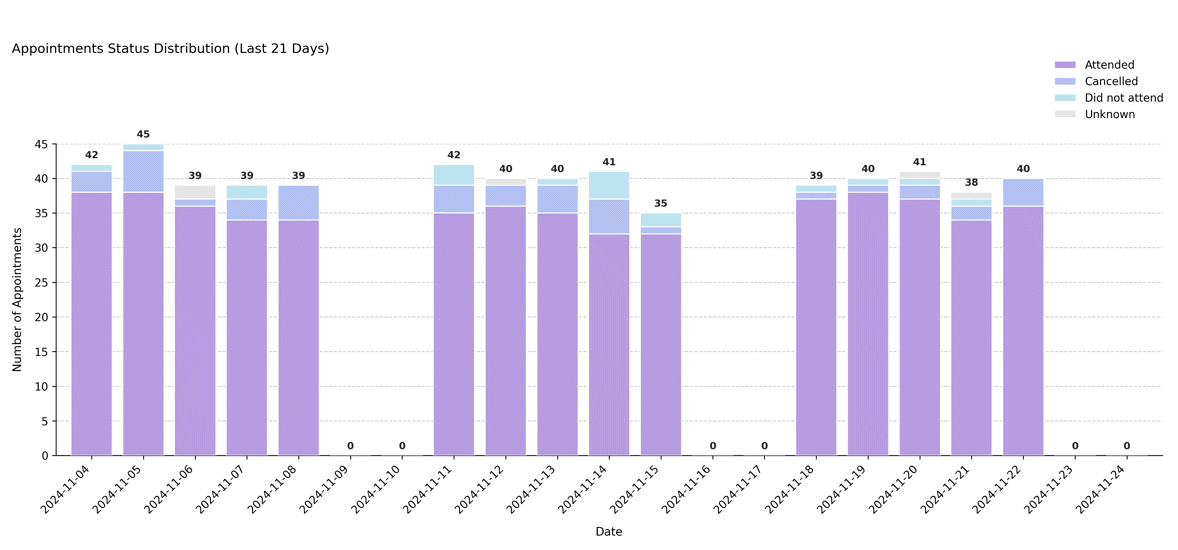
Recent daily activity (past 21 days) – Trends in attended vs. missed appointments.
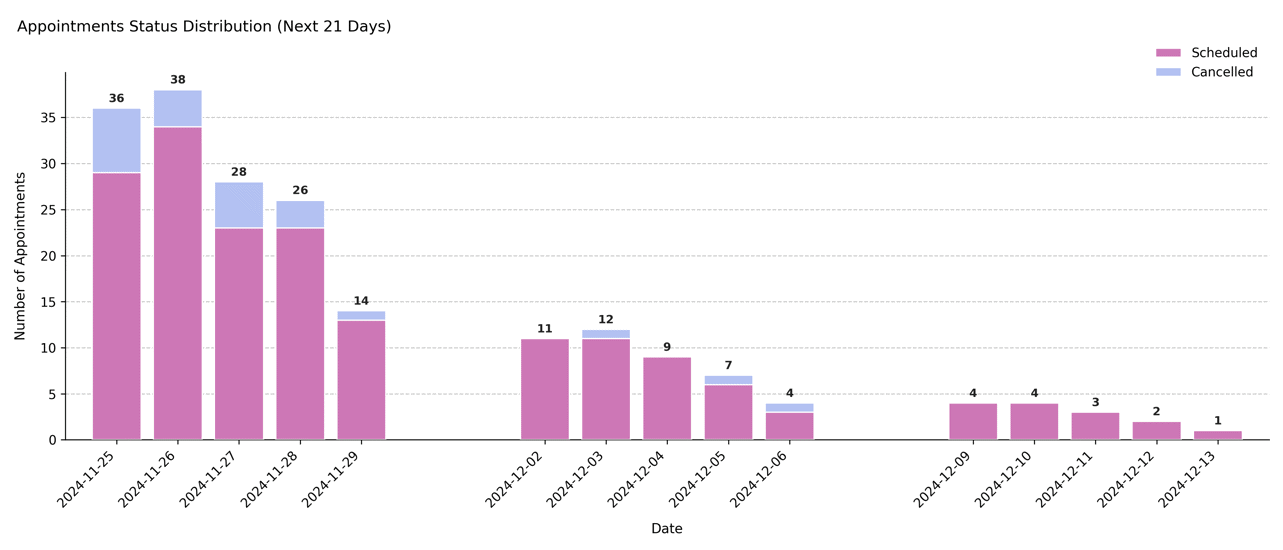
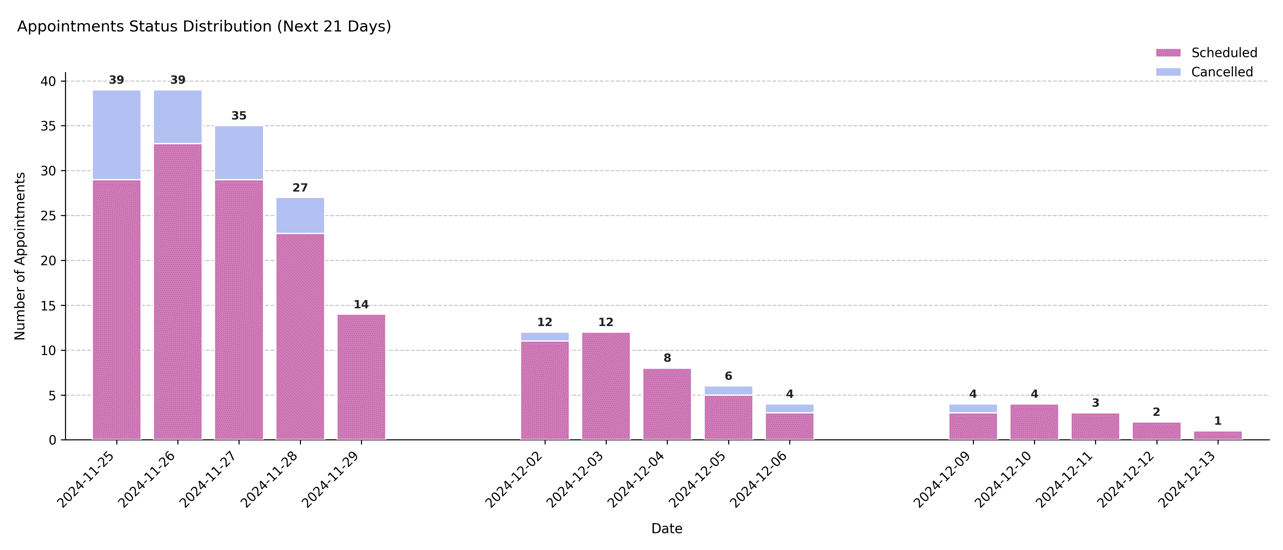
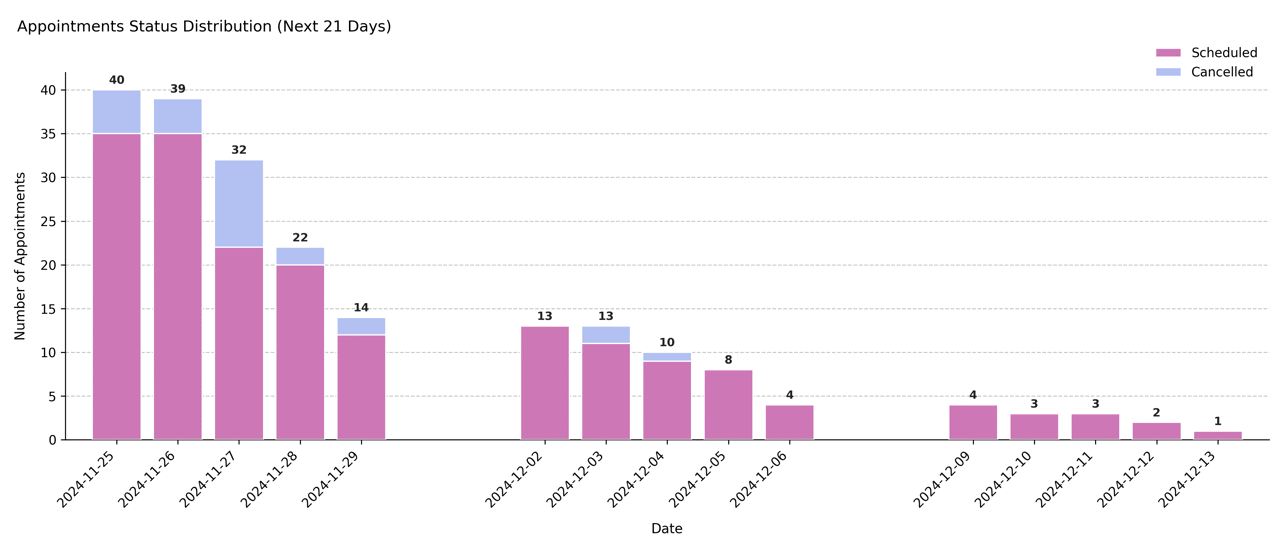
Upcoming daily bookings (next 21 days) – Near-term expected activity.
Interpretation:
Attendance follows a balanced pattern: most patients attend, a smaller share cancel, and few miss appointments. About half of the cancelled visits are rebooked, keeping utilization stable over time.
Example 2 – No-rebooking system (low adaptability)#
A rigid scheduling model where cancelled appointments are never rebooked.
This setup mimics systems with poor patient follow-up or limited administrative capacity.
sched_norebook = AppointmentScheduler(
    date_ranges=[("2024-01-01", "2024-12-31")],
    ref_date="2024-11-25",
    fill_rate=0.85,
    status_rates={"attended":0.75,"cancelled":0.15,"did not attend":0.09,"unknown":0.01},
    rebook_category="min"
)

slots_df, appts_df, patients_df = sched_norebook.generate()

plot_appointments_by_status(appts_df, scheduler=sched_norebook)
plot_appointments_by_status_future(appts_df, scheduler=sched_norebook)
plot_status_distribution_last_days(appts_df, scheduler=sched_norebook, days_back=21)
plot_status_distribution_next_days(appts_df, scheduler=sched_norebook, days_ahead=21)
Output preview:
Below are the four main outputs for this configuration:
Past appointment outcomes – Shows lower overall completion rates due to unrebooked cancellations.
Future appointment outcomes – Demonstrates reduced forward occupancy and more open capacity.
Recent daily activity (past 21 days) – Displays visible dips following cancellation spikes.
Upcoming daily bookings (next 21 days) – Shows empty days ahead due to missing reschedules.
Interpretation:
With no rebooking, cancellations directly reduce throughput.
Future occupancy remains lower, making this configuration representative of clinics that cannot replace missed visits quickly.
Example 3 – Fully adaptive scheduling (maximum rebooking)#
A highly responsive service where all cancelled appointments are immediately rebooked, and non-attendance rates are minimal.
sched_rebookmax = AppointmentScheduler(
    date_ranges=[("2024-01-01", "2024-12-31")],
    ref_date="2024-11-25",
    fill_rate=0.9,
    status_rates={"attended":0.85,"cancelled":0.10,"did not attend":0.04,"unknown":0.01},
    rebook_category="max"
)

slots_df, appts_df, patients_df = sched_rebookmax.generate()

plot_appointments_by_status(appts_df, scheduler=sched_rebookmax)
plot_appointments_by_status_future(appts_df, scheduler=sched_rebookmax)
plot_status_distribution_last_days(appts_df, scheduler=sched_rebookmax, days_back=21)
plot_status_distribution_next_days(appts_df, scheduler=sched_rebookmax, days_ahead=21)
Output preview:
Below are the four main outputs for this configuration:
Past appointment outcomes – Almost all historical slots are attended or rebooked.
Future appointment outcomes – Shows a nearly filled forward calendar with minimal cancellations.
Recent daily activity (past 21 days) – Displays consistently high attendance and rapid recovery from cancellations.
Upcoming daily bookings (next 21 days) – Maintains high occupancy across future days.
Interpretation:
This system maximizes capacity by instantly recycling cancellations into new bookings. Attendance remains strong, future utilization near complete, and daily activity stable — typical of high-efficiency environments.
Summary#
Scenario |
|
Attendance pattern |
Utilization outcome |
|---|---|---|---|
Balanced |
|
Typical mix of attended/cancelled/DNA |
Stable utilization |
No rebooking |
|
Lower throughput, cancellations lost |
Declining occupancy |
Full rebooking |
|
Almost all cancellations recovered |
Near-max efficiency |
Next Steps#
Examine how attendance influences patient flow in Patient flow.
Explore Appointments table for how outcomes are stored.
See Booking dynamics for how fill rate and scheduling affect these behaviors.
Continue with Appointment Timing and Daily Flow to link attendance outcomes with punctuality and visit timing.