
Appointment Timing and Daily Flow#
Overview#
The timing parameters check_in_time_mean and the internal appointment duration model define how early patients arrive and how long visits last.
Together, they determine the temporal flow of the simulated clinic — when patients arrive, how long they wait, and how consultations overlap throughout the day.
You will explore:
Typical punctuality and consultation duration patterns.
How late arrivals affect clinic flow and waiting times.
How early arrivals can improve coordination and reduce delays.
Example 1 – Standard punctuality and consultation time#
A typical outpatient clinic where most patients arrive slightly early and sessions last around 15–20 minutes.
from medscheduler import AppointmentScheduler
from medscheduler.utils.plotting import (
    plot_arrival_time_distribution,
    plot_waiting_time_distribution,
    plot_appointment_duration_distribution
)

sched_standard = AppointmentScheduler(
    date_ranges=[("2024-01-01", "2024-03-31")],
    ref_date="2024-03-15",
    check_in_time_mean=-10,  # average 10 min early
    fill_rate=0.85
)

slots_df, appts_df, patients_df = sched_standard.generate()

# Visualizations
plot_arrival_time_distribution(appts_df)
plot_waiting_time_distribution(appts_df)
Output preview:
Below are the main visualizations for this baseline scenario:
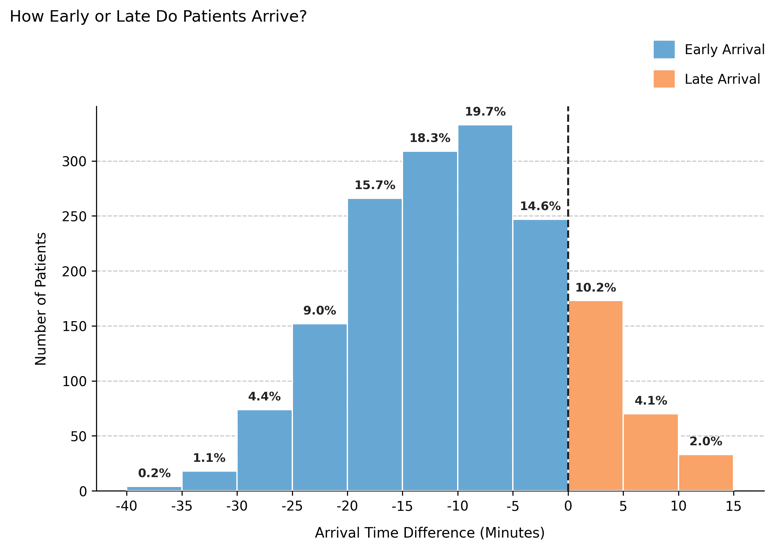
Arrival time distribution – Most patients check in between 5–15 minutes early.
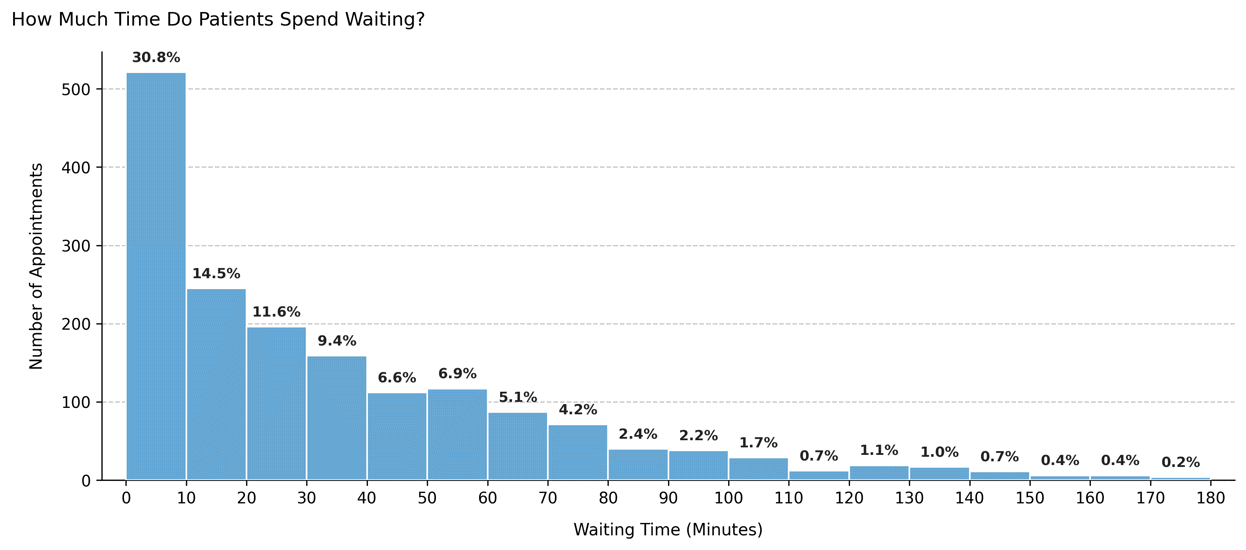
Waiting time distribution – Median waiting ≈ 5 minutes, showing efficient flow.
Appointment duration model (internal behavior)#
The simulator assigns consultation durations to attended visits using a fixed stochastic model — not a user parameter — ensuring realistic variability in service length.
# Visualize the internal appointment duration model
plot_appointment_duration_distribution(appts_df)
Output preview:
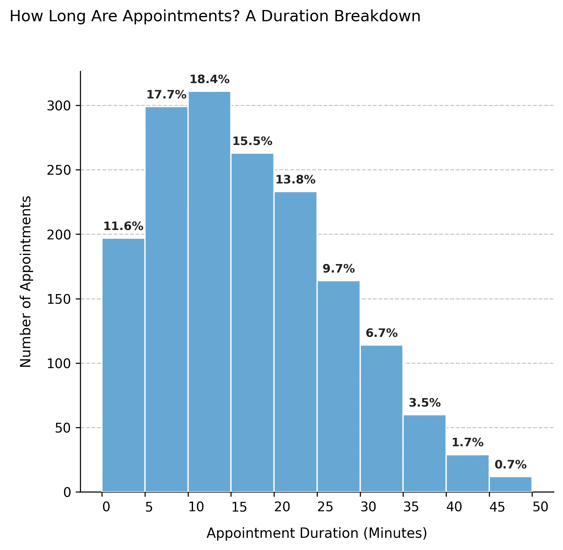
Appointment duration distribution – The internal Beta(1.48, 3.6) model produces realistic session lengths (mean ≈17 min, median ≈16 min).
Explanation:
Durations follow a Beta(1.48, 3.6) distribution scaled to 0–60 min.
This yields short right-skewed sessions with typical times between 10 – 25 min.
Derived from Tai-Seale et al. (2007), these values approximate observed patterns in primary care.
This distribution interacts with arrival times to shape overall waiting patterns — even when punctuality is ideal, short or long sessions can affect subsequent delays.
Example 2 – Frequent late arrivals#
A clinic where patients often arrive after their scheduled time, causing downstream delays.
sched_late = AppointmentScheduler(
    date_ranges=[("2024-01-01", "2024-03-31")],
    ref_date="2024-03-15",
    check_in_time_mean=5,   # average 5 min late
    fill_rate=0.85
)

slots_df, appts_df, patients_df = sched_late.generate()

plot_arrival_time_distribution(appts_df)
plot_waiting_time_distribution(appts_df)
Output preview:
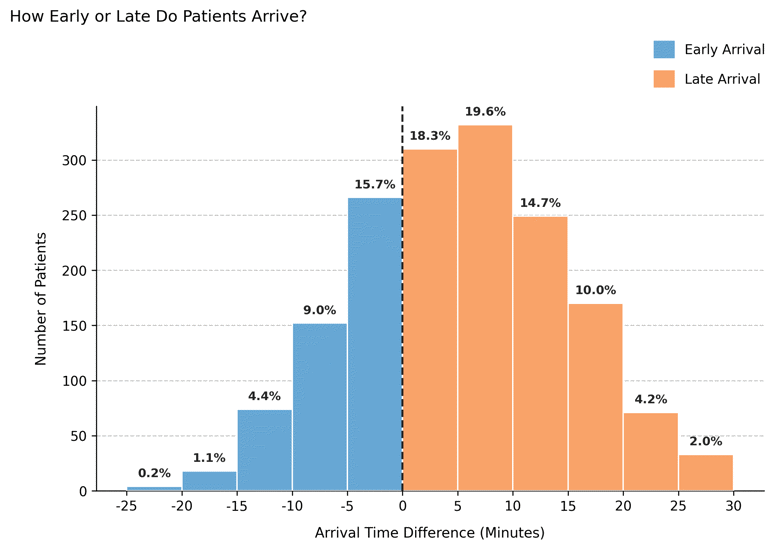
Arrival time distribution – Skewed toward later arrivals, showing frequent tardiness.
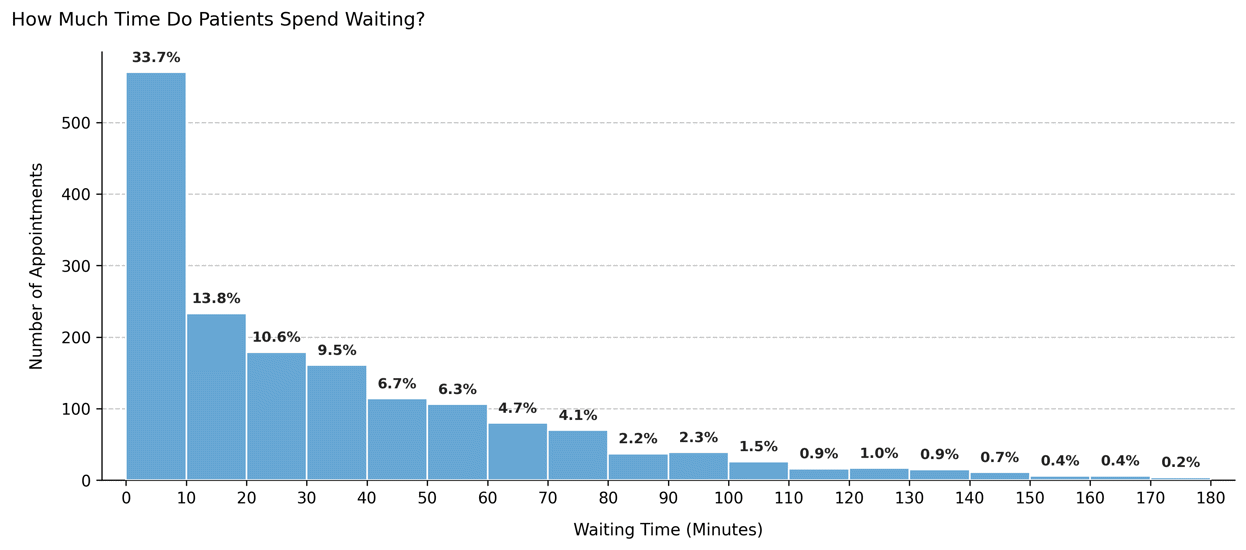
Waiting time distribution – Broader and asymmetric, as delays accumulate downstream.
Interpretation:
When patients arrive late on average, waiting times become irregular and less predictable.
This scenario represents real clinics struggling with punctuality compliance, where even minor delays propagate through the day.
Example 3 – High-efficiency morning clinic#
A tightly managed setting where patients arrive well in advance, minimizing idle time between consultations.
sched_fast = AppointmentScheduler(
    date_ranges=[("2024-01-01", "2024-03-31")],
    ref_date="2024-03-15",
    check_in_time_mean=-15,  # very early arrivals
    fill_rate=0.9
)

slots_df, appts_df, patients_df = sched_fast.generate()

plot_arrival_time_distribution(appts_df)
plot_waiting_time_distribution(appts_df)
Output preview:
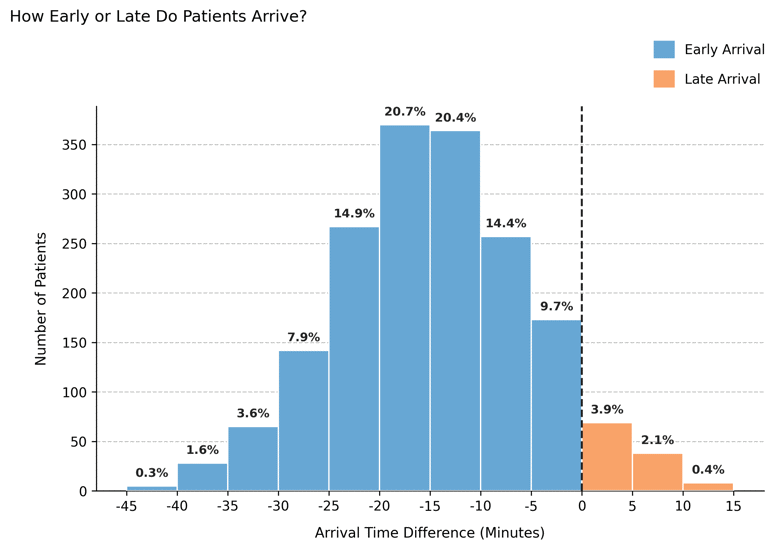
Arrival time distribution – Concentrated around −15 minutes, most patients early.
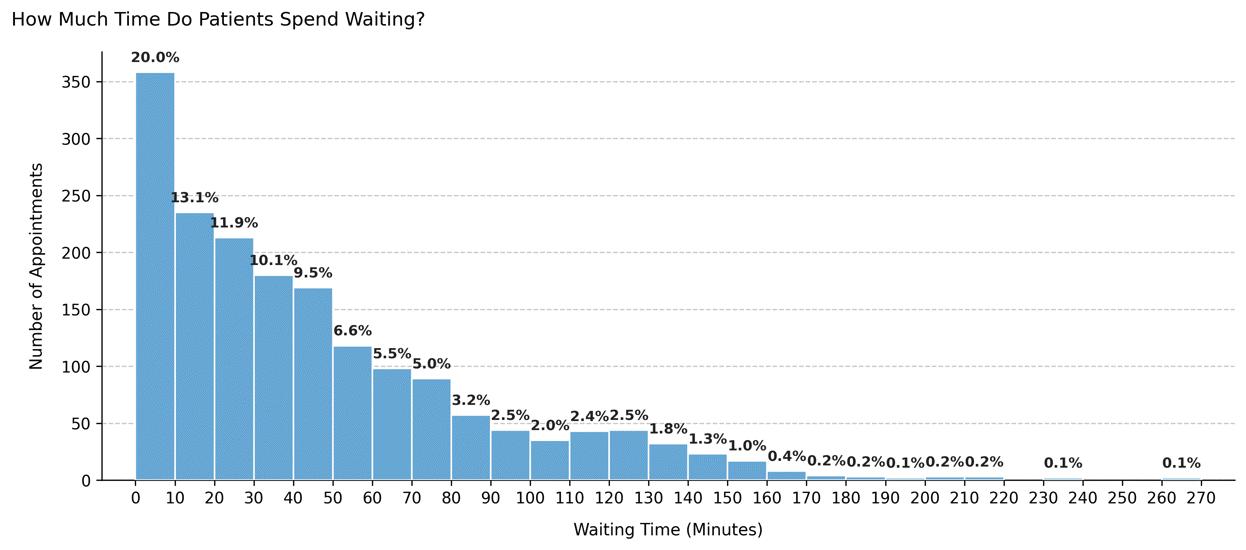
Waiting time distribution – Lower median wait (< 3 min) due to synchronized readiness.
Interpretation:
Early arrivals and steady throughput yield minimal idle time and consistent session flow.
This configuration suits high-volume diagnostics or vaccination sessions where speed and regularity are prioritized.
Summary#
Scenario |
|
Behavior |
Typical waiting time |
Operational impact |
|---|---|---|---|---|
Standard |
−10 min |
Early punctuality |
~5 min |
Balanced and efficient |
Late arrivals |
+5 min |
Patients often delayed |
>10 min |
Variable and delayed |
Fast clinic |
−15 min |
Very early arrivals |
<3 min |
Smooth and consistent |
Notes#
Arrival-time patterns directly control waiting-time distributions.
Appointment durations are fixed by the internal Beta(1.48, 3.6) model, independent of punctuality.
Flow stability depends on the interaction between punctuality, duration variability, and fill rate.
Next Steps#
Examine Appointments table for time variables.
Review Randomness and variability to understand stochastic components.
Explore Attendance behavior to connect punctuality with attendance outcomes.
Revisit Patient Flow and Demographic Structure to analyze how demographic traits affect punctuality trends.